

Dermatofibrosarcoma Protuberans (DFSP)
Dermatofibrosarcoma protuberans (DFSP) was first described by Jean Darier and Marcel Ferrand in 1924. They identified the tumor as a progressive skin sarcoma with a tendency to recur locally. In 1925, Erwin Hoffmann gave the tumor its current name, dermatofibrosarcoma protuberans, because of its characteristic raised appearance.
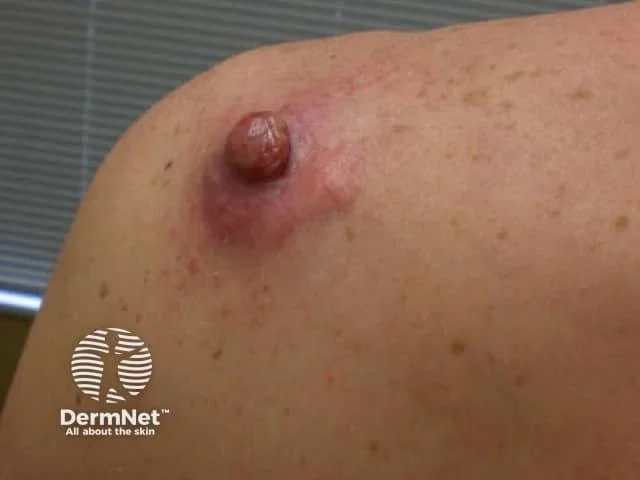
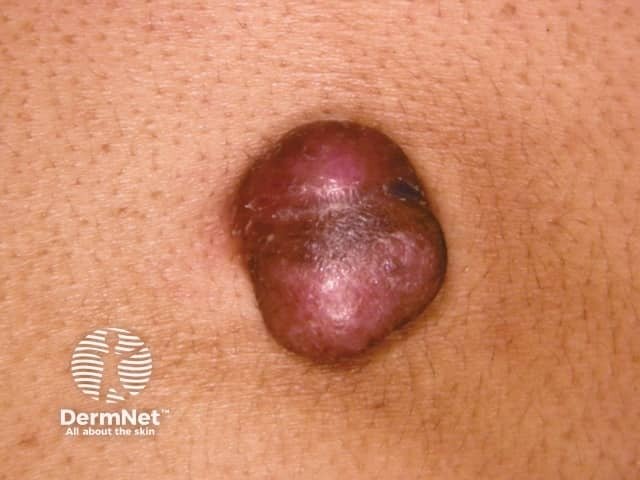
Dermatofibrosarcoma protuberans most commonly develops on the trunk, including the chest, abdomen, and back. It can also occur on the shoulders, upper arms, legs, and, less commonly, the head and neck. The tumor begins in the dermis, or middle layer of the skin, and may grow into the tissue beneath the skin.
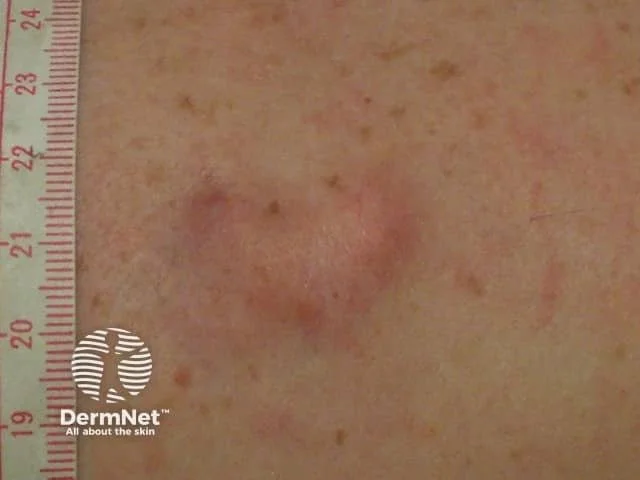
There is no standard size for dermatofibrosarcoma protuberans because it grows slowly over time. At diagnosis, many tumors measure between 2 and 5 centimeters (20–50 millimeters or about 0.8–2 inches) in diameter. However, untreated tumors may become much larger and extend into deeper tissues.
The exact cause of dermatofibrosarcoma protuberans is not fully understood. Most cases result from a genetic mutation that links the COL1A1 and PDGFB genes. This genetic fusion causes skin cells to produce excessive growth signals, leading to tumor development. This mutation is acquired during a person's lifetime and is not inherited.
Although the exact cause remains unknown, researchers believe that previous skin injuries, surgical scars, burns, tattoos, radiation exposure, or chronic skin trauma may contribute to the development of DFSP in some individuals. However, these associations are uncommon, and most cases develop without any identifiable risk factor.
Dermatofibrosarcoma protuberans most commonly occurs in adults aged 20 to 50 years. Although it is rare, it can also occur in children and older adults.
The most common treatment for dermatofibrosarcoma protuberans is Mohs micrographic surgery or wide local excision to completely remove the tumor. Radiation therapy may be used if the tumor cannot be fully removed or if there is a high risk of recurrence. In advanced or metastatic cases, targeted therapy with Imatinib may be recommended because it blocks the abnormal protein produced by the genetic mutation.
Dermatofibrosarcoma protuberans is rarely deadly because it usually grows slowly and has a very low risk of spreading to distant parts of the body. However, it is considered a locally aggressive cancer, meaning it can grow deeply into nearby skin, fat, muscle, and other tissues if left untreated. Early diagnosis and complete surgical removal provide an excellent prognosis, with cure rates greater than 90%.
visual images
〰️
visual images 〰️


Medical references (Source)
American Cancer Society. (2024). Soft tissue sarcoma: Dermatofibrosarcoma protuberans.
National Cancer Institute. (2024). Dermatofibrosarcoma protuberans treatment (PDQ).
National Comprehensive Cancer Network. (2025). NCCN Clinical Practice Guidelines in Oncology: Soft Tissue Sarcoma.
National Organization for Rare Disorders. (2024). Dermatofibrosarcoma protuberans.
Rutgers, E. J. T., Kroon, B. B. R., Albus-Lutter, C. E., & Gortzak, E. (1992). Dermatofibrosarcoma protuberans: Treatment and prognosis. European Journal of Surgical Oncology.